

Getting your brand included in a “best” or “top” list can do more than add another backlink to your profile.
These articles often appear when people are comparing products, services, software, agencies, or tools. They can bring referral traffic, put your brand in front of potential customers, and create a third-party reference that describes where your business fits within a category.
That makes listicle link building particularly interesting as search becomes more conversational.
The strategy is simple in theory: find relevant listicles, identify where your brand belongs, and earn a placement. In practice, the quality of the publication, the relevance of the article, the reason for inclusion, and the way you approach the publisher all matter.
The best campaigns don’t start by asking, “Where can I get a backlink?”
They start with:
“Which lists are already influencing the way people discover and compare businesses in my category?”
This guide breaks the process into five stages:
Discover → Verify → Score → Pitch → Maintain
What Is Listicle Link Building?
Listicle link building is the process of earning a backlink and brand mention by getting a business, product, or service included in a relevant list-style article.
Common examples include:
- Best SEO tools for small businesses
- Top accounting software for startups
- Best digital marketing agencies
- Leading project management platforms
- Best alternatives to [product]
- Top [service] providers in [location]
For example, a project management platform designed for marketing agencies could benefit from being included in a genuine article about the best project management tools for marketing teams.
The value comes from the context.
The reader is already comparing solutions, so your brand is appearing at a point where the product or service is relevant to the decision being made.
A good placement can provide three things at once:
- A relevant backlink
- A third-party brand mention
- Exposure to an audience actively researching the category
The backlink is only one part of the opportunity.
Why Listicles Matter For AI Search
Listicles have long been useful for commercial searches because they allow readers to compare several options on one page.
That same format has become relevant to AI-powered search.
A 2026 Ahrefs study of 26,283 AI-search source URLs associated with 750 prompts found that best-of listicles represented 43.8% of the pages cited by ChatGPT in that research. That figure shouldn’t be treated as a universal percentage for every AI answer, but it does demonstrate why list-style content deserves attention when researching AI visibility.
The practical lesson is more useful than the statistic itself:
Find out which third-party pages are already being used to answer buyer questions.
If an AI search platform repeatedly references a particular comparison or best-of article, that page may be worth investigating as a prospect.
This creates a different approach to link prospecting.
Instead of:
Website database → filter by metrics → outreach
you can use:
Buyer query → search results and AI citations → identify listicles → evaluate opportunity → outreach
That is a much more focused way to build a prospect list.
Step 1: Discover The Right Listicles
Start with the questions your potential customers ask before choosing a product or service.
Use four types of searches.
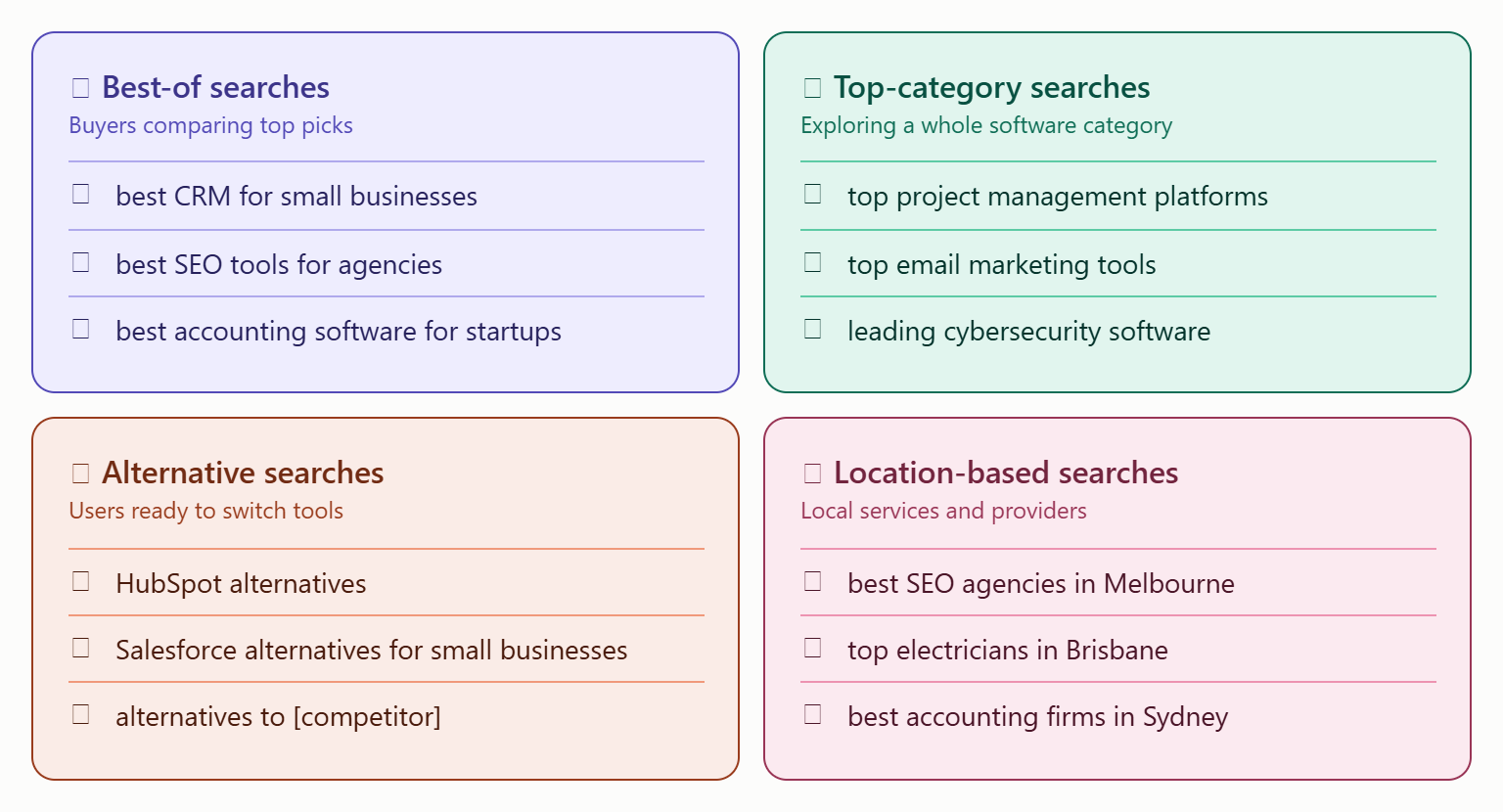 Record the listicles that repeatedly appear.
Then run important commercial questions through relevant AI search platforms and note the sources behind the answers.
Don’t only record which brands appear.
Record which publications are being cited.
A source that appears across several related buyer questions deserves more attention than a page that shows up once for a loosely related query.
Step 2: Find Competitor Gaps
Competitor research can make this process faster.
Suppose you discover 30 relevant listicles.
Your competitors appear in 18.
Your brand appears in four.
That doesn’t mean you should contact all 14 remaining publishers. First, understand why the competitors were included.
Look at:
- Their position in the list
- The audience they are recommended for
- Their key differentiators
- The information the publisher uses
- Whether the article has been updated
- Whether there is a genuine gap your business can fill
For example, if a list already has several enterprise products but nothing designed for smaller teams, a small-business solution may have a legitimate reason to be considered.
The pitch should come from that editorial gap, not from the fact that you simply want another backlink.
Step 3: Verify The Publication
Not every listicle is a worthwhile opportunity.
Before outreach, check:
Relevance: Does the topic closely match your industry?
Audience: Are the readers potential customers?
Organic visibility: Does the article rank or attract search traffic?
Freshness: Is the content maintained?
Editorial quality: Does the writer actually explain why each option is included?
Link profile: Are outbound links natural, or does the site appear to publish links mainly for commercial purposes?
Authority: Is the publication recognised within its niche?
Don’t let a single metric make the decision.
A smaller industry publication with a relevant audience may be more useful than a high-metric website that has nothing to do with your market.
Step 4: Score Your Prospects
Once you’ve collected a larger list, use a simple scoring system to decide where your outreach team should spend its time.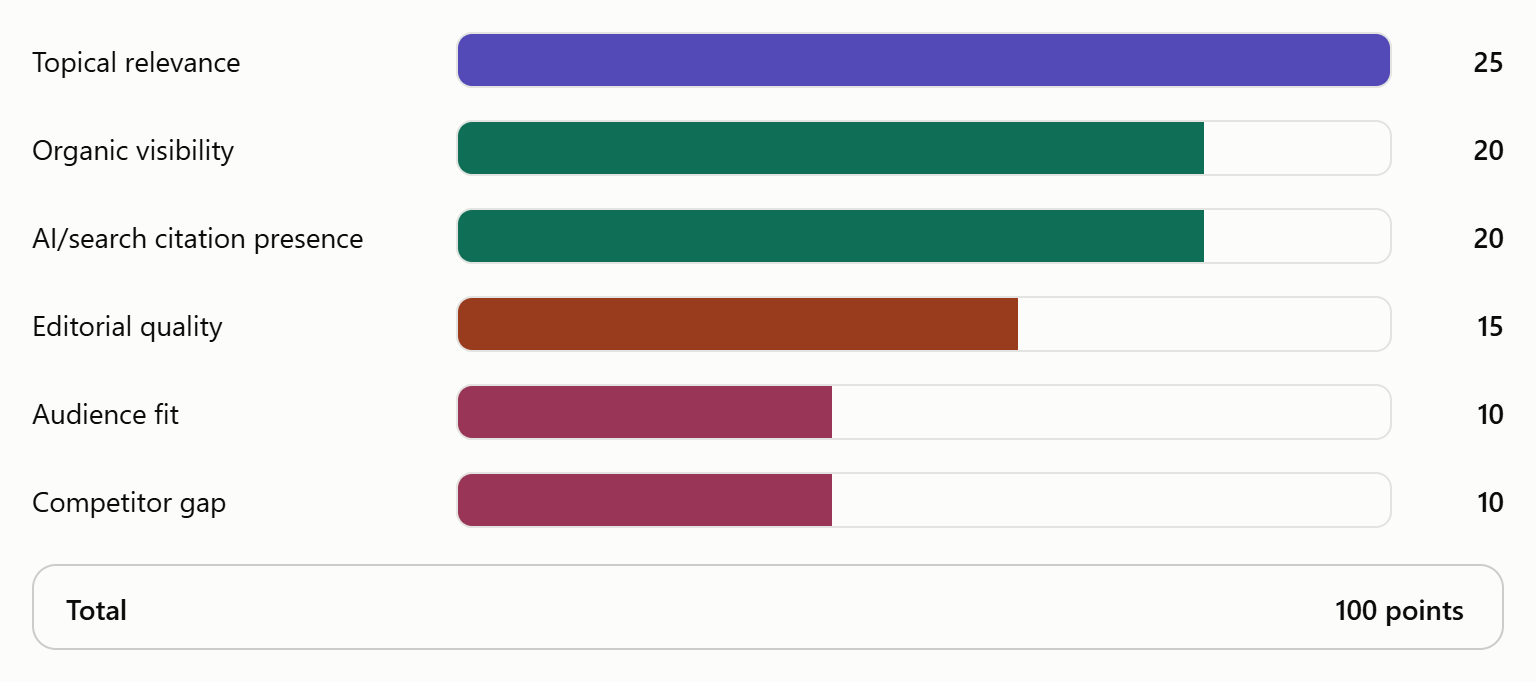 80–100: Priority
Strong candidates for immediate outreach.
60–79: Good prospect
Worth pursuing after the highest-value opportunities.
40–59: Review further
Investigate the page and publication before investing much outreach time.
Below 40: Low priority
Usually not worth prioritising unless there is a specific business reason.
The scoring isn’t meant to predict exactly how much a backlink is worth. It simply creates a consistent process for deciding which opportunities deserve attention.
Step 5: Prepare A Reason For Inclusion
Before contacting an editor, answer one question:
Why should this brand be on this list?
Avoid vague reasons such as:
“We are a leading company and would love to be featured.”
Instead, identify something specific.
Perhaps the article covers enterprise solutions but doesn’t have an option for small businesses.
Maybe the article hasn’t added a solution that launched recently.
Perhaps your product specialises in a particular use case that the existing list doesn’t address.
That is the information the editor can actually evaluate.
Step 6: Create A Simple Entry Brief
Make it easy for the publisher to research your business.
Include:
- Brand name
- Product or service
- Best-fit customer
- Main use case
- Two or three useful features
- Key differentiator
- Pricing, if relevant
- Supporting facts
- Official URL
For example:
Brand: Example CRM
Best for: Small sales teams
Key strength: Simple pipeline automation
Differentiator: Built specifically for teams that don’t need enterprise-level complexity
Pricing: Starts at $X/month
URL: Official product page
Don’t write a full advertisement.
Give the publisher enough information to decide whether the product deserves a place.
Step 7: Write Outreach That Gives The Editor A Reason To Care
The strongest outreach usually refers to the actual article.
A simple structure is:
Subject: Possible addition to [article title]
Hi [Name],
I was reading your “[article title]” and noticed that it currently covers [existing category/options], but doesn’t have an option specifically for [audience/use case].
[Brand] may be worth considering because [specific differentiator].
I’ve included the relevant product details here: [resource].
If you’re planning another update, happy to provide anything else you need.
Thanks,
[Name]
Keep it short.
The objective isn’t to convince the editor that your company is wonderful. It’s to give them a legitimate editorial reason to consider an addition.
Don’t Force Exact-Match Anchors
If the publisher chooses to include your brand, let the link fit naturally into the article.
Brand names, product names, URLs, and descriptive phrases can all work.
Trying to force an exact commercial keyword into every placement can make an otherwise natural recommendation look manufactured.
The surrounding sentence should make sense to a reader first.
What About Paid Listicle Placements?
Some publishers charge for inclusion, sponsorship, or promotional coverage.
Treat these opportunities carefully.
Google’s current spam policies define link spam as practices used primarily to manipulate rankings, including buying or selling links for ranking purposes. Google also says paid links used for advertising are acceptable when appropriately qualified, such as with nofollow or sponsored attributes.
So don’t judge a paid placement solely by whether it provides a followed backlink.
Consider:
- Is the publication relevant?
- Does it have a genuine audience?
- Is the article useful?
- Is the commercial relationship handled appropriately?
- Would the placement make sense to readers?
- Is the link treatment appropriate?
If the only reason for buying a placement is to manipulate rankings, it isn’t a sound long-term strategy.
Step 8: Maintain Your Listicle Placements
Winning the link is not the end.
Listicles change frequently.
A publisher may update:
- Product rankings
- Pricing
- Screenshots
- Features
- Competitors
- Product descriptions
Your brand may eventually disappear from a list, or an old URL may become broken.
Keep a placement tracker containing: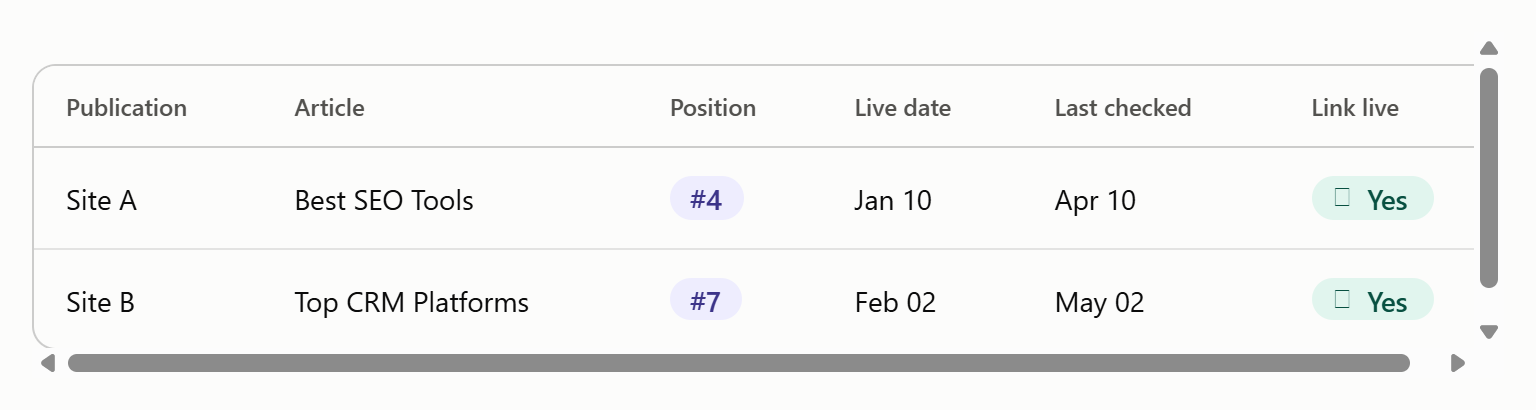 Review important placements periodically.
If a link disappears after an article update, don’t immediately treat it as lost forever.
Check what changed and whether you have new information that could make the brand relevant again.
How To Measure Listicle Link Building
Don’t judge the campaign only by the number of backlinks acquired.
Track:
SEO
- Referring domains
- Target-page rankings
- Organic traffic
- Commercial keyword visibility
- Link longevity
Brand
- Referral traffic
- Branded searches
- Brand mentions
- Competitor comparison visibility
AI Search
Create a fixed set of buyer prompts and check them periodically.
For example:
What are the best [category] tools for small businesses?
Which [service providers] are best for [use case]?
What are the best alternatives to [competitor]?
Record:
- Whether your brand appears
- Which competitors appear
- Which sources are cited
- Which listicles are repeatedly referenced
Don’t claim that one backlink caused an AI recommendation. Use the data to identify broader visibility patterns.
Listicle Link Building Mistakes To Avoid
Chasing Metrics Alone
High authority doesn’t compensate for poor relevance.
Targeting Every Listicle
A page should have a genuine connection to your business.
Sending The Same Pitch Everywhere
Editors can tell when an email was sent to 100 sites.
Overpromoting Your Brand
Give publishers useful information, not advertising copy.
Forcing Anchor Text
Natural editorial placement should take priority.
Ignoring Article Freshness
Old listicles may no longer have active audiences or accurate information.
Buying Links Without Checking The Publication
A paid placement isn’t automatically valuable simply because the website has a high authority score.
Forgetting Link Maintenance
A backlink that disappears six months later shouldn’t be counted as a permanent campaign win.
Listicle Quality Checklist
Before approving a placement, ask:
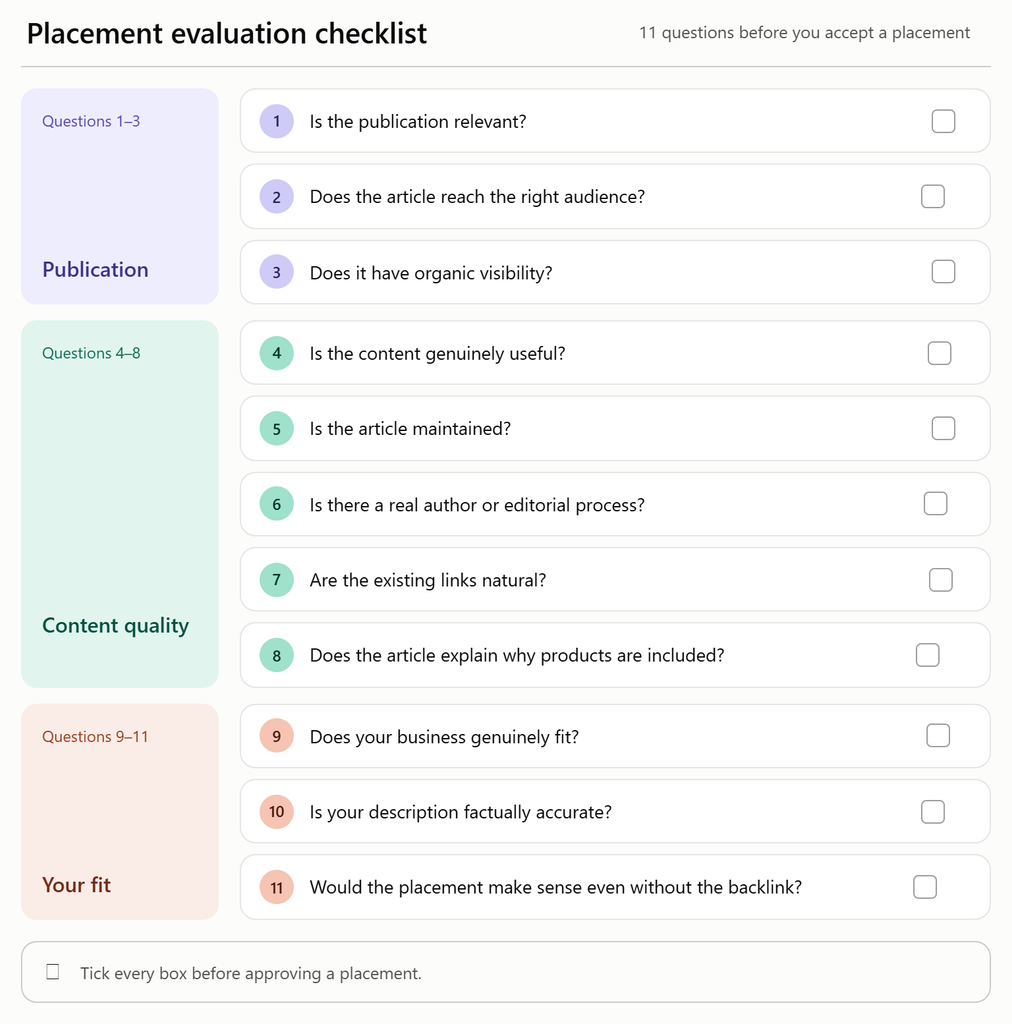
If several answers are no, move on.
Final Takeaway
Listicle link building is more useful when you stop treating it as a numbers game.
The objective isn’t to collect as many “best-of” links as possible.
It’s to find the pages that already matter to your customers, understand why those pages are being surfaced in search, and give publishers a genuine reason to include your brand.
The process can be summed up simply:
 Find the lists your audience already uses. Check where competitors are appearing. Evaluate the publication instead of relying on one SEO metric. Make your outreach relevant. Then monitor the placements after they go live.
That approach makes listicle link building useful beyond traditional backlink acquisition. It can support referral traffic, brand visibility, third-party credibility, and a broader online presence that search engines and AI-powered search systems can draw from.
There are no shortcuts or guaranteed AI citations. The strongest strategy is still the straightforward one: earn your place on pages where your business genuinely belongs.

Share, Earn, Repeat
Sign up, share your link, and earn every time someone makes a purchase!
Sign up and earn

Leave a Comment